Procedure
Ultrasonic Rhinoplasty
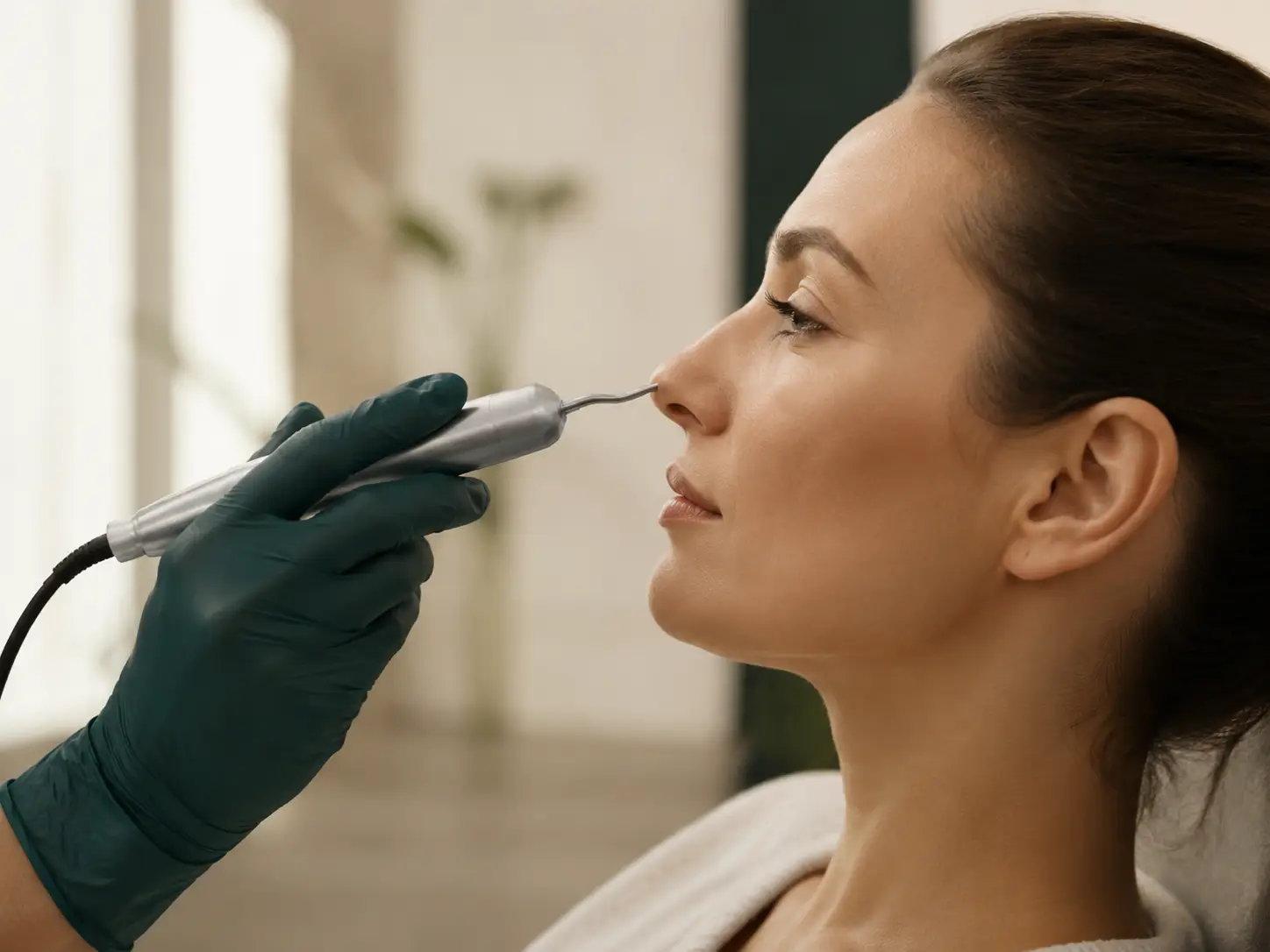
Ultrasonic rhinoplasty shapes the nasal bones with a piezoelectric handpiece, not a chisel and mallet. Piezo rhinoplasty is the same thing. In pooled randomised trials it is associated with modestly less bruising and swelling in parts of the first week. No trial shows a better final shape, lower revision rate or faster recovery, and the reviewers rated the certainty low.
The short answers
- What actually changes
- The instrument, not the operationPiezoelectric tips shape bone and hard cartilage. The cartilage work, skin envelope and healing biology are unchanged.
- Bruising benefit
- Significant on days 2, 4 and 7Roughly half a point lower on subjective grading scales, in a meta-analysis of 12 randomised trials.
- Swelling benefit
- Significant on days 2 and 7 onlyThe same meta-analysis found no statistically significant difference in swelling on days 1, 3 and 4.
- Certainty of the evidence
- Rated low by the reviewersAll 12 trials carried risk of bias concerns, none had a public protocol, and swelling was scored subjectively.
- Operating time
- No reliable pooled estimate existsThe trials disagreed too strongly to combine, with a heterogeneity statistic of 98.31 percent.
- Effect on the final result
- Not demonstrated in any published trialTrial follow up was under 7 days, so the evidence says nothing about the settled shape at one year.
Ultrasonic rhinoplasty cuts and shapes the nasal bones with a handpiece driven by high frequency sound waves. Piezo rhinoplasty and piezoelectric rhinoplasty are other names for the same technology, not other operations.
Claims made for the device usually run ahead of the published data, so this page sets out what randomised trials measured. The comparison with conventional rhinoplasty sets the two side by side.
What ultrasonic rhinoplasty actually is
It is conventional rhinoplasty with one instrument swapped. A piezoelectric handpiece replaces the rasp, osteotome and mallet used to reshape the bony vault, the upper third of the nose.
A crystal inside the handpiece vibrates at an ultrasonic frequency, carrying a fine tip with it. Soft tissue is elastic and moves with the vibration, so the tip cuts bone and hard cartilage while mucosa and small vessels are left substantially undisturbed.
Everything else is worked by hand and unchanged: the septum, the tip cartilages, any grafting, the skin envelope and the healing biology. An operation with no bone work, such as a tip plasty, gives the device nothing to do.
What the pooled trials measured
A 2024 systematic review and meta-analysis in the Journal of Clinical Medicine pooled 12 randomised controlled trials. Those trials covered 292 patients treated with piezoelectric instruments and 338 treated with conventional osteotomy.
| Measure | Mean difference, piezoelectric versus conventional |
|---|---|
| Bruising, day 2 | 0.58 points lower, 95 percent confidence interval 0.26 to 0.89 |
| Bruising, day 4 | 0.68 points lower, interval 0.34 to 1.03 |
| Bruising, day 7 | 0.51 points lower, interval 0.11 to 0.92 |
| Swelling, day 2 | 0.59 points lower, interval 0.15 to 1.02 |
| Swelling, day 7 | 0.39 points lower, interval 0.08 to 0.70 |
| Swelling, days 1, 3 and 4 | No statistically significant difference at all |
Pooled data favoured piezoelectric surgery for overall complications and for injury to the nasal lining during surgery. Bleeding after surgery was not significantly different.
These are fractions of a point on subjective grading scales, not the difference between bruising and none. Most patients still bruise and swell after either technique.
How reliable this evidence is
Not very. The reviewers rated the certainty low, citing high heterogeneity and questionable methodological quality.
- All 12 trials carried at least some risk of bias concerns. None had a public protocol, bruising and swelling were scored subjectively, and age, sex, anatomy and comorbidity went uncontrolled.
- A separate systematic review in Aesthetic Plastic Surgery, 8 randomised trials in 440 patients, found less pain and less nasal lining injury with piezoelectric osteotomy. Only two papers measured that injury.
- Short term swelling was reduced in 75 percent of those papers and bruising in 87.5 percent.
- Every study in that review followed patients for under 7 days. Its authors say longer trials are needed to understand the reduction in swelling.
- A meta-analysis of six trials in 327 patients found no significant advantage for piezoelectric osteotomy when conventional osteotomy was done under direct vision rather than blind.
- Operating time cannot be pooled. The difference was not statistically significant and the trials disagreed too strongly, with a heterogeneity statistic of 98.31 percent.
A piezoelectric tip has to see what it cuts, so the bone is exposed and the dissection wider. Part of the measured benefit may come from that exposure, not the ultrasound.
What ultrasonic surgery does not change
The result and the recovery. No published trial demonstrates a better final nose shape, a lower revision rate, better breathing or better quality of life.
A radiological comparison of 60 adults, 30 treated with piezoelectric surgery and 30 with classical osteotomy, found similar long term aesthetic outcomes. Functional results were better in the piezoelectric group, in one small study.
In that same study, the safe margin to the nasolacrimal canal, the tear duct beside a lateral osteotomy, was narrower with piezoelectric instruments (p equals 0.025 right, 0.010 left). A reason for care, not for avoidance.
StatPearls reports revision rates after rhinoplasty of up to 15 percent and complication rates of around 3 percent. No instrument has been shown to move either, and none makes revision less difficult.
The splint still comes off at around a week, swelling still peaks at roughly 7 to 14 days, and the recovery timeline is unchanged.
What this means for choosing a surgeon
A surgeon will assess whether the plan involves the bony vault at all. Where it does not, the instrument is not part of the decision.
The handpiece is slower in unfamiliar hands, so fluency matters more than ownership. A clinic offering the device as the reason to choose it has described its equipment, not its surgery.
Check the surgeon, not the machine
Any clinic can buy a handpiece and name it in an advertisement. What decides the result is the surgeon holding it, and why they would choose that instrument for your bridge. Our doctors will answer that in writing.
Questions to ask a surgeon
Take these to a consultation. The consultation checklist is built to be printed and written on, and our doctors will answer questions sent through the site before you travel.
- Does my plan involve work on the nasal bones at all, or is the instrument irrelevant to my case?
- How often do you use the piezoelectric handpiece, and how long have you been using it?
- Are your conventional osteotomies made under direct vision, or by feel?
- How much wider is the dissection when the bone has to be exposed for a piezoelectric tip?
- What do you expect this to change in my first week, and what will it not change at one year?
- If the settled shape at twelve months is not what we planned, what is your policy on revision surgery?
Sources
Every source below was opened and checked. We link to health authorities, peer-reviewed journals and professional bodies, and to nothing else.
- Is piezosurgery associated with improved patient outcomes compared to conventional osteotomy in rhinoplasty? A systematic reviewJournal of Clinical Medicine, via PubMed CentralSystematic review, and the reason this site does not claim ultrasonic surgery is universally superior.
- A comparison between piezosurgery and conventional osteotomies in rhinoplasty on post-operative oedema and ecchymosisAesthetic Plastic Surgery, via PubMed CentralMeta-analysis of the specific claim that piezo reduces bruising and swelling.
- RhinoplastyStatPearls, NCBI Bookshelf (National Library of Medicine)Peer-reviewed clinical reference covering anatomy, technique selection and complications.