Blog
Pollybeak deformity: the fullness above the tip that outlasts swelling
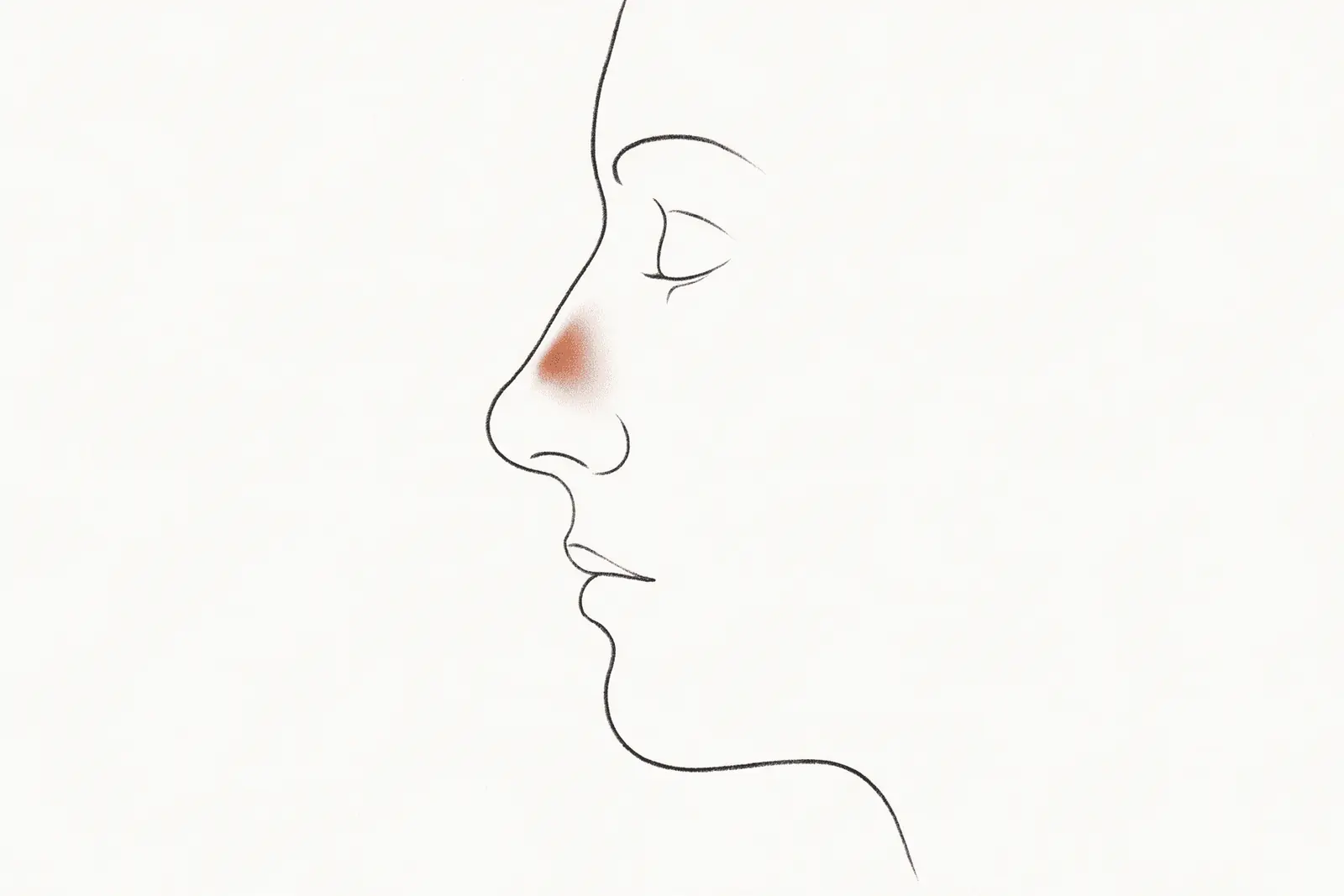
A pollybeak is a fullness just above the tip of the nose, so that in profile the lower bridge sits higher than the tip, like a parrot's beak. It is best known as a result of rhinoplasty. In the first months after surgery, most fullness in that spot is swelling and goes down by itself. This post explains how surgeons tell the two apart, the two kinds of pollybeak, why each happens, and what the evidence shows for each treatment.
The short answers
- What it is
- Fullness just above the tip The area above the tip is rounded and stands out, so the tip looks lower than the bridge.
- Is it swelling
- In the first months, usually Surgeons generally wait about a year before calling it a pollybeak.
- Two kinds
- Scar tissue, or cartilage and bone What the fullness is made of decides what can treat it.
- How common
- 36 per cent of people asking for a second operation, in one study It was found in 40 of 112 revision candidates. No study we found gives a reliable rate after a first rhinoplasty.
- Steroid injections
- The usual first treatment for the scar kind The studies are small. In the only randomised trial we found, surgeons rated an improvement that patients did not, and the effect was temporary.
- Surgery
- Needed for the cartilage and bone kind A revision is normally planned at least 12 months after the first operation.
The question usually comes a few months after surgery, from a profile photograph or a reflection: the bridge looks smooth, and then there is a rise just above the tip. Whether it will go down is the first thing to know, and that depends on what it is made of.
About this post
Fullness above the tip can be present in a nose that has never been operated on, but the word pollybeak is mostly used for a result of surgery, and that is what this post is mainly about. Some of that surgery is done in Istanbul. How this site is funded, and what that means for what we write, is set out in our conflicts of interest policy.
What a pollybeak is
Seen from the side, most noses have a slight dip just above the tip, where the bridge ends and the tip begins. Surgeons call this area the supratip, and the dip the supratip break.
In a pollybeak the dip is gone. The supratip is rounded and stands out, and the tip looks as if it sits lower than the bridge. A medical reference text describes the result as "conveying the appearance of a parrot's bill", which is where the name comes from.

Some papers call it a supratip deformity, and it is spelled both "pollybeak" and "polly beak". All three mean the same thing.
A pollybeak is not the same as a bump higher up the bridge. A hump left behind after surgery, or a ridge where bone was cut, sits higher, over the bony part of the nose.
Swelling or pollybeak: what the first year can and cannot tell you
Some fullness above the tip in the months after rhinoplasty is expected, and on its own it says little. How long swelling takes to go down, and how soft the usual one-year figure is, are covered in our post on swelling. This section is about a narrower question: how does a surgeon decide that fullness above the tip is something more?
There is no single test. A surgeon looks at several things together:
- Whether it is changing. Swelling goes down over weeks and months. Fullness that stays the same from one review to the next, or grows, points away from swelling.
- How it feels. On examination, soft fullness that can be pressed flat suggests swelling or early scar, and firm fullness suggests cartilage. This is done by a surgeon who knows what was done at the operation; it is not a test to do at home.
- How thick the skin is. Scar above the tip is more common in thick skin, as the section on causes below explains.
- What was done at the operation. How much of the bridge was lowered, and what was done to the tip, tells a surgeon whether the framework itself is likely to stand out.
Waiting for the year to pass does not always mean doing nothing. A study published in 2000 described a stepped approach: early fullness that could still be pressed flat was taped, and if it had not responded after six to eight weeks, low-dose steroid injections were given and repeated at four-week intervals. A review published in 2023 makes the same point from the other side: "Medical intervention is only effective for soft-tissue pollybeaks when caught early."
Photographs help more than a mirror, because they can be compared over time. Lighting and the distance of the camera both change how a nose looks, so take each picture the same way. Our guide to reading before and after photographs explains what to keep the same.
The two kinds
Pollybeaks are divided by what the fullness is made of, because that decides what can treat it.
Soft tissue pollybeak. When surgery lowers the bridge, the skin over it has to shrink down onto a smaller framework. Where it does not shrink enough, a space is left under the skin above the tip, and that space can fill with scar tissue. In the 2000 study, surgeons looked at tissue taken from above the tip under a microscope. They found significant scarring in 14 of 16 patients having a second operation who had not been given steroid injections.
Structural pollybeak. Here the fullness is the framework itself. The cartilage just above the tip may have been left too high. The tip may have lost support and dropped, so the area above it now stands higher than the tip. Or the bony part of the bridge may have been taken down further than the cartilage below it, so the cartilage stands out.
In a series of 100 pollybeaks published by surgeons at an Istanbul university in 2024, the cause was scarring above the tip in 48 per cent, weak tip support in 28 per cent and a bony bridge taken down too far in 24 per cent. We could read only the study's abstract.
The difference matters for treatment. A steroid can shrink scar and swelling. It cannot lower cartilage or lift a tip.
Why it happens, and what thick skin has to do with it
The 2000 study looked at the causes separately in people asking for a first rhinoplasty and in people asking for a second one.
In noses that had not been operated on, fullness above the tip came from a tip without enough projection, so that the area above it looked high by comparison (the authors call this a pseudodeformity), from too much height at the lower end of the bridge, or from tip cartilages angled upwards.
After a previous operation, the causes were the lower end of the bridge taken down too little or too far, the middle of the bridge taken down too far, a tip without enough projection, or a combination of these.
Thick skin. The 2023 review notes that supratip scar tissue "is more common in people with thick skin". Skin thickness can be measured: a study at Hacettepe University in Ankara measured the nasal skin of 42 patients with thick skin by ultrasound, before surgery and 40 days after it. The men in that study had thicker nasal skin than the women at every point measured.
None of this means a pollybeak always comes from a mistake. The 2023 review describes part of the risk as unpredictable, and the authors of the Istanbul series write that excess scarring above the tip is "not directly related to a surgical error". Scar forms differently in different people. Where the cause is structural, the shape of the framework was set at the operation, and it can be corrected.
How much of a hump to take off, and how the bony and cartilage parts of the bridge are balanced, is covered on our dorsal hump page. A tip that droops by itself, without any surgery, is a different problem, covered on the droopy tip page.
How often it happens
The figures most often quoted come from the 2000 study, and they are often quoted wrongly. Among 298 people asking for a first rhinoplasty, 26 already had fullness above the tip, 9 per cent. Among 112 people asking for a second operation, 40 had it, 36 per cent.
So fullness above the tip was one of the more common problems in people who wanted a revision. The study does not say how often a pollybeak follows a first operation, and no study we found gives a reliable figure for that. The study came from one centre, more than 25 years ago, and we could read only its abstract.
How often revisions happen in general is covered in our post on revision rhinoplasty.
Treatment without surgery
Steroid injection. The usual first treatment for the soft kind is a steroid, triamcinolone, injected under the skin above the tip. The aim is to reduce swelling and slow the formation of scar in the space under the skin. It does nothing to cartilage or bone, so it is not a treatment for the structural kind.
The evidence for it is weaker than clinic pages tend to suggest:
- One surgeon's series, 2002. Patients were injected one week after surgery, and many again at four weeks. The surgeon judged the result acceptable in 85 per cent. There was no comparison group, and no complications from the injections were reported. We could read only the abstract.
- A study from Ankara, 2021. Of 42 patients with thick skin, half were given one injection on day 10. At day 40, ultrasound showed thinner skin above the tip in the injected group and thicker skin in the others. Forty days is too short to say anything about the final shape.
- A randomised trial, 2017. Ninety patients were split into three groups: no injection, or one of two strengths. Surgeons rated the result better in the injected groups. Patients' own ratings and measurements on photographs did not differ, and the two strengths did no better than each other. The authors describe the effect as temporary. We could read only the abstract.
- A systematic review, 2024. Six studies with 1,524 patients. The authors describe the injections as a first-line treatment with "limited complications" and call for randomised trials.
- A scoping review, 2023. Eighteen studies on preventing and treating the soft kind. The authors found no high-level evidence for any method, so how well each one works is still uncertain. Most studies were small, used subjective measures and had a high risk of bias.
Steroid injection is a reasonable thing to try for the soft kind, and it is what most of these studies offer first. The proof that it changes the final shape is thin.
Risks. The prescribing information for triamcinolone lists thinning of the skin and the tissue beneath it, lighter or darker patches of skin, and thin, fragile skin among its side effects. The US label says the site and amount of an injection should be chosen carefully because of the risk of thinning. Too much thinning above the tip would leave a dip instead of a rise.
The UK product information also records cases of blindness after corticosteroid suspensions were injected into the nasal turbinates, inside the nose. That is a different place from the area above the tip, but it is one reason the injection should be given by a doctor trained in injecting the face.
Why the advice on timing differs. Early and later injections do different jobs. Injections in the first weeks are meant to stop scar forming: the 2002 series injected at one week, the Ankara study on day 10. Later injections treat fullness that has not gone down, as in the stepped approach above. A surgeon who says "wait" and another who says "inject now" may be talking about different stages.
Doses. We have left doses out of this post on purpose. The amount, strength and spacing depend on the nose and the skin, and they belong to the doctor giving the injection. The questions at the end of this post cover what to ask.
Taping. Taping the area above the tip is often advised in the early months. The 2000 study used it for early fullness that could still be pressed flat. The 2023 scoping review found no high-level evidence for it, or for any other non-surgical method.
Filler. Filler placed around the fullness can sometimes disguise it, by building up the areas next to it. It does not correct a pollybeak, and filler in a nose that has already been operated on carries risks of its own. Filler is covered on our non-surgical rhinoplasty page.
Treatment with surgery
When the fullness is cartilage or bone, or scar that has not responded to injection, the treatment is a revision. What it changes depends on the cause:
- cartilage left too high above the tip is trimmed down
- a tip that has lost support is supported again, often with a cartilage graft, so that it sits higher than the area above it
- scar in the space above the tip is removed
- where the bony bridge was taken down too far, a cartilage graft may be used to build it back up
In the Istanbul series of 100 patients, the treatments were cartilage trimming in 30 per cent, steroid injection in 28 per cent, restored tip support in 28 per cent, a graft in 14 per cent and filler in 6 per cent. The figures add up to more than 100 because some patients had more than one.
A revision for a pollybeak is normally planned at least 12 months after the first operation, once swelling and scar have settled enough to judge the shape. Why the wait is that long, and where graft cartilage comes from, are set out in our post on revision rhinoplasty. How a tip is supported is covered on the tip plasty page.
If your surgeon is in another country
Most of what is written about pollybeaks assumes the surgeon is a short drive away. For anyone who travelled for surgery, the practical problem is different: the treatments for the soft kind need someone in the room.
- Injections are given in person, and a course is spread over weeks. The 2000 study repeated them at four-week intervals. One trip back rarely covers it.
- Who will see you at home is the question to settle before booking. Ask whether your surgeon will share the operation notes with a doctor near you, and whether they will advise that doctor.
- In the UK, triamcinolone is a prescription-only medicine. The UK product information we checked licenses the injection for joints and muscles. A doctor injecting it above the tip is using it outside that licence, and should explain that before you agree.
- Photographs keep your surgeon involved between visits. Take them the same way each time, in the same light, at the same distance and from the same angle, and send them as often as your surgeon asks.
- The written quote should say what follow-up is included, for how long, and what the revision policy covers. What a quote must include lists the rest, the before you travel checklist covers arranging care at home, and our post on complication rates abroad gives the wider picture.
Questions to ask a surgeon
Take these to a follow-up appointment or a consultation. The consultation checklist is built to be printed and written on.
- Is the fullness above my tip swelling, scar or cartilage, and how did you decide?
- How thick is my skin, and how does that change your plan or your timing?
- If you suggest a steroid injection, how many, how far apart, and what will you do to limit skin thinning?
- What would make you stop injecting and suggest surgery instead?
- If I live abroad, who will see me and give any injections at home?
- If I need a revision, what will be changed, and what does your revision policy cover?
Sources
Every source below was opened and checked. We link to health authorities, peer-reviewed journals and professional bodies, and to nothing else.
- Supratip deformity: a closer look Guyuron B, DeLuca L, Lash R. Plastic and Reconstructive Surgery, 2000, via PubMed Fullness above the tip in 298 first rhinoplasty and 112 revision candidates, its causes, and treatment by taping and injection; abstract only.
- Pollybeak deformity: how to avoid, how to cure European Review for Medical and Pharmacological Sciences, 2023, via PubMed A review of causes, thick skin and treatment; abstract only.
- Pollybeak deformity in rhinoplasty: prevention and treatment European Review for Medical and Pharmacological Sciences, 2024, via PubMed Causes and treatments in 100 cases, Istanbul Nişantaşı University; abstract only.
- Correction of the soft tissue pollybeak using triamcinolone injection Archives of Facial Plastic Surgery, 2002, via PubMed One surgeon's series of early injections; abstract only.
- Comparison of two concentrations of triamcinolone injection in the prevention of supratip edema after external rhinoplasty: a randomized trial American Journal of Rhinology and Allergy, 2017, via PubMed Ninety patients in three groups; abstract only.
- Role of steroid injection for skin thickness and edema in rhinoplasty patients Laryngoscope Investigative Otolaryngology, 2021, via PubMed Central Ultrasound skin thickness in 42 patients with thick skin, Hacettepe University.
- Efficacy and safety of triamcinolone acetonide injections following rhinoplasty: a systematic review of recommended doses, complications, and outcomes Aesthetic Plastic Surgery, 2024, via PubMed Six studies, 1,524 patients; abstract only.
- Prevention and non-surgical treatment of soft tissue polly beak deformity after rhinoplasty: a scoping review Journal of Cranio-Maxillofacial Surgery, 2023, open access Eighteen studies on prevention, injection and taping.
- Rhinoplasty StatPearls, NCBI Bookshelf, updated September 2024 The definition and the structural causes.
- Kenalog-10 (triamcinolone acetonide) injectable suspension, prescribing label DailyMed, US National Library of Medicine, revised August 2024 Skin side effects and the advice on choosing the injection site.
- Kenalog Intra-articular / Intramuscular Injection 40 mg/mL, summary of product characteristics Electronic Medicines Compendium, revised September 2023 UK prescription status, licensed routes, skin side effects and the warning on injection into the nasal turbinates.
Dr. Şuheda Çıldır, one of the surgeons listed on this site, qualified in medicine at Hacettepe University. She is not an author of the Hacettepe study above.