Blog
Does a septoplasty change how your nose looks?
A septoplasty is done for the airway, not the face, and ENT UK's leaflet says the operation is not meant to change the way your nose looks. It then lists a slight change of shape among the complications and says it can be common, with no number behind it. In a randomised trial, 17 of 171 people in the surgery arm reported a change in appearance at six months. The largest series we opened says its authors saw external deformities in less than 1 per cent, with no count published. Three kinds of statement, kept apart here.
The short answers
- What the operation is for
- Not the way the nose looksENT UK patient leaflet on septal surgery, verbatim: the operation is not meant to change the way your nose looks. A statement to patients, with no denominator.
- The same leaflet, under complications
- A slight change can be commonENT UK lists a dip in the bridge or a change in the shape of the nostrils, and says most people do not notice any significant change. It gives no percentage, sample size or denominator for it.
- Reported in a randomised trial
- One of its listed harmsIn the funder's report on the NAIROS trial, a change in the appearance of the nose was one of the harms the surgery arm reported at six months. Each harm there carries its own reporting denominator, and this item's count and denominator are set out below.
- In a 5,639-operation series
- Authors say less than 1 per centA single centre, January 2009 to December 2016, records complications of any kind in 193 patients (3.42 per cent). For external nose deformity its authors state less than 1 per cent and publish no count.
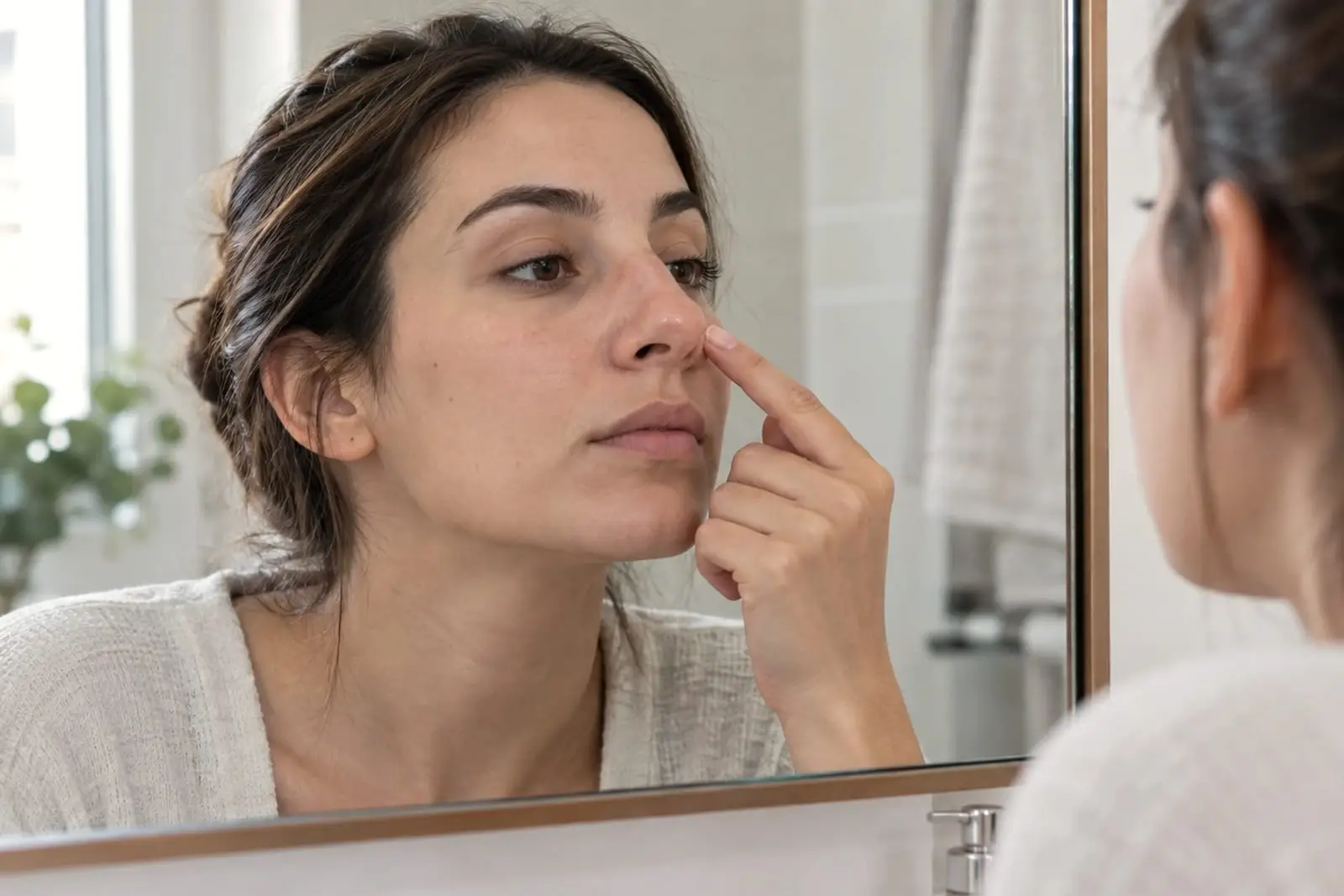
The question is usually not what a photograph would show, but whether an operation done for breathing has altered a face.
One leaflet gives two answers
ENT UK, the British professional body, publishes a patient leaflet on the septal operation itself. Everything below is what it tells patients, not a measurement of anybody, and the leaflet gives no percentage, sample size or denominator for a change of shape.
| In the leaflet | What it says |
|---|---|
| What it is for | The operation is not meant to change the way your nose looks |
| What to expect | We do not expect black eyes or a change in the shape of the nose after this operation |
| Under complications | Some patients find the shape of their nose has changed slightly, with a dip in the bridge of the nose or a change in shape of their nostrils |
| Same entry | Most people do not notice any significant change, but if you are not happy with it, further surgery can be considered. This can be common |
The leaflet's only frequency figure is about blockage
ENT UK says the septum sometimes cannot be completely straightened, or can bend again after surgery, causing further blockage, and that this can happen in one out of ten cases. It belongs to a blocked nose, not the shape of one, and the leaflet gives no sample size behind it, and no timepoint to shape at all.
How often it happens, and why the sources disagree
The fullest figure we opened comes from the NAIROS trial: 378 adults at 17 National Health Service clinics, 188 randomised to septoplasty and 190 to medical management. In the funder's report, 17 of 171 participants in the surgery arm, 10 per cent, reported a change in the appearance of the nose at six months. Each harm there carries its own reporting denominator, and 171 is this item's. The rest of that harms column is read elsewhere.
Against that sits a single centre series of 5,639 septal operations between January 2009 and December 2016, with complications of any kind in 193 patients, 3.42 per cent, gathered retrospectively from medical records. On appearance its authors write that they have seen external nose deformities in less than 1 per cent, publish no count for it, and add that it is hard to say with certainty whether it was a complication, because a noticeable tip or nostril asymmetry, or a displaced septum, was already there beforehand. Nor was it the septal operation alone: 2,784 had septoplasty only and 2,855 had it combined with lower turbinate surgery. Follow-up averaged 12 to 34 months, and 3.68 per cent were lost to it.
They disagree, and this page is not picking
A body saying a slight change can be common, and one hospital's authors saying less than 1 per cent, are not the same kind of claim, and neither publishes what would settle it. The abstract of the trial's own monograph counts 132 adverse events in the surgical arm against 95 in the medical one, and itemises none of them.
What the sources name, and what they leave out
Neither source describes what changes beyond naming it: ENT UK names a dip in the bridge and a change in the shape of the nostrils, and the series' authors name the difficulty of attributing it. No source on this page says why one nose changes and another does not, or how long after the operation a change becomes visible.
Where the shape is the point rather than a side effect, that is a different operation: septorhinoplasty addresses the airway and the shape together. Nothing we verified compares the two on how the nose looks afterwards. Why a photograph cannot diagnose an airway is in the breathing guide.
If you think your nose has changed
A pair of photographs of your own nose settles less than people expect, and what they can and cannot establish is set out in how to read a before and after.
The person who can compare your nose with the one on the operating table is the surgeon who operated. On being unhappy with a change, ENT UK says further surgery can be considered; that is the leaflet's sentence, not a recommendation from here. Timings, packing and splints are in septoplasty recovery, and the consultation checklist has room for answers.
This is a question about one nose
A change noticed months later belongs to one operative record and one starting shape, and no page on this site can answer it from a distance. Nothing published here, including what settles in the first year after a cosmetic operation, describes your nose.
Questions to ask a surgeon
Take these to a consultation. The consultation checklist is built to be printed and written on, and our doctors will answer questions sent through the site before you travel.
- Did the operation involve any part of the septum that supports the bridge or the tip of my nose?
- Were my nostrils or my tip already asymmetric before the operation, and is that recorded anywhere?
- Is what I am seeing now swelling that will settle, or a change in the structure?
- Do you have photographs of my nose taken before the operation, and in which views?
- If the shape has changed and I am unhappy with it, what are the options, and who would carry them out?
- Is my breathing better, worse or unchanged, measured against the score taken before the operation?
Sources
Every source below was opened and checked. We link to health authorities, peer-reviewed journals and professional bodies, and to nothing else.
- Septal surgeryENT UKBritish professional body patient information on septal surgery alone, with its timings for packing, splints, nose blowing, work and clearer breathing.
- Complications in septoplasty based on a large group of 5639 patientsEuropean Archives of Oto-Rhino-Laryngology, via PubMed CentralA single-centre series of 5,639 septoplasties, 2009 to 2016, with each complication counted against the whole group and septoplasty alone compared with septoplasty plus turbinate surgery.
- Clinical effectiveness of septoplasty versus medical management for nasal airways obstruction: multicentre, open label, randomised controlled trialThe BMJ, via PubMedThe NAIROS trial. Randomised evidence that septoplasty outperforms medical management in adults with obstruction associated with a deviated septum.
- Scientific summary: effectiveness of septoplasty compared to medical management in adults with obstruction associated with a deviated nasal septum, the NAIROS randomised controlled trialNIHR Journals Library, via NCBI Bookshelf (National Library of Medicine)The funder's own report of the trial, including what each arm actually received and the difference the trial had judged meaningful before it began.
- Effectiveness of septoplasty compared to medical management in adults with obstruction associated with a deviated nasal septum: the NAIROS RCTHealth Technology Assessment, via PubMedThe journal monograph of the NAIROS trial, whose abstract counts 132 adverse events in the surgical arm and 95 in the medical management arm of 378 adults randomised 188 to septoplasty and 190 to medical management, 14 serious against nine, and itemises none of them.